
.webp&w=3840&q=75)
RFX, RFP, RFQ, RFI.Here is when to use each.
A plain-English breakdown of every procurement document type, with a decision framework so you always pick the right one.
RFX is the umbrella term for all “Request for X” procurement documents. RFP (Request for Proposal) is one specific type. Other types include RFI (Request for Information), RFQ (Request for Quote), and RFS (Request for Solution). Think of it like “vehicle” vs “sedan”: RFX is the category, RFP is one type within it.
Lesson 01
The RFX Family: Understanding Each Type
The “X” in RFX is a placeholder for different document types, each serving a specific purpose in the sourcing lifecycle.
For a full breakdown of each type, see What is RFX? RFP, RFI & RFQ Explained. The quick version: RFI explores the market, RFP evaluates complex proposals, RFQ compares on price, and RFS invites vendor-led solutions.
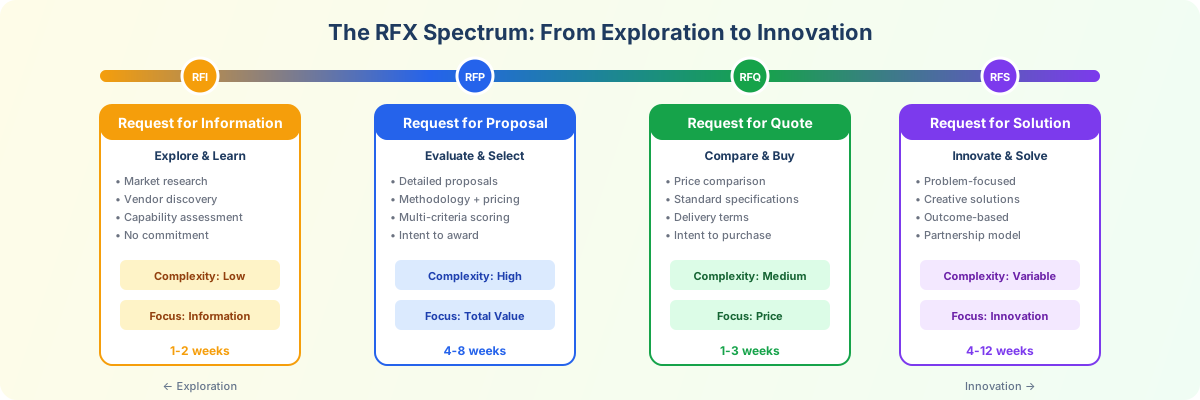
Figure 1: The RFX spectrum, from exploration (RFI) to innovation (RFS)
Quick check
Think you can tell RFI, RFP, RFQ, and RFS apart? Test yourself with a quick quiz.
Lesson 02
Side-by-side comparison.
How the four document types compare across the criteria that matter most when choosing.
| Criteria | RFI | RFP | RFQ | RFS |
|---|---|---|---|---|
| Purpose | Gather info | Get proposals | Compare prices | Invite solutions |
| Complexity | Low | High | Medium | Variable |
| Commitment | No obligation | Intent to award | Intent to buy | Problem-focused |
| Evaluation focus | Capabilities | Total value | Price | Innovation |
| Typical timeline | 1-2 weeks | 4-8 weeks | 1-3 weeks | 4-12 weeks |
| Vendor effort | Low (1-2 days) | High (1-3 weeks) | Medium (2-5 days) | High (2-4 weeks) |
| Best for | Market research | Complex services | Commodities | Innovation needs |
Lesson 03
How to choose the right RFX type.
Use this framework based on what you know and what you need from the process.
You are exploring the market, identifying potential vendors, or defining requirements. An RFI helps you understand what is available before committing to a formal procurement.
You have defined requirements but need vendors to propose solutions. RFPs are ideal for complex services, IT implementations, consulting, and custom solutions.
You know exactly what you need and want the best price. RFQs work for standard products, materials, software licenses, and well-defined services.
You have a business challenge but want vendors to propose creative solutions. RFS documents leverage vendor expertise and encourage innovative thinking.
Lesson 04
Real-world scenarios.
How each RFX type applies in common procurement situations.
RFI
Exploring Cloud ERP Options
Your company is considering migrating from on-premise ERP to cloud. You do not know which vendors exist or what is possible.
Send an RFI to 10-15 vendors asking about capabilities, pricing models, migration approaches, and timelines. Use responses to create a shortlist for a future RFP.
RFP
Enterprise Software Implementation
You need a CRM system with specific integrations, user counts, and SLA requirements. Multiple evaluation criteria matter beyond price.
Issue an RFP with detailed requirements, evaluation criteria (40% functionality, 30% price, 20% experience, 10% support), and a structured response format.
RFQ
Office Furniture Refresh
You need 200 ergonomic chairs and 50 standing desks. Exact specifications are defined. Price is the primary factor.
Send an RFQ with item specifications, quantities, delivery requirements, and a pricing template. Award to the lowest-cost qualified vendor.
RFS
Customer Experience Redesign
Your customer satisfaction scores are declining. You do not know the root cause or the best approach to fix it.
Issue an RFS describing the problem, business objectives, and constraints. Let vendors propose innovative solutions: technology, process, design, or a combination.
Sequential RFX: using multiple types in one sourcing event
Many sourcing events use RFX types in sequence: an RFI to shortlist vendors, then an RFP for detailed proposals, and finally an RFQ for competitive pricing from finalists. A unified platform makes these transitions seamless, keeping the audit trail intact across all three stages.
Lesson 05
Common mistakes to avoid.
Mismatching the document type to the situation is the most avoidable source of wasted procurement effort.
Using an RFP when you need an RFI
If you do not have clear requirements yet, an RFP will produce low-quality, non-comparable proposals. Start with an RFI to define your needs first.
Using an RFQ for complex services
RFQs focus on price. For complex services where approach, methodology, and experience matter, an RFP gives you the information needed to make a good decision.
Being too prescriptive in an RFS
The point of an RFS is to let vendors propose solutions. If you already know the solution, use an RFP instead. Over-prescribing kills innovation.
Skipping RFX for high-value purchases
Sole-sourcing without competitive bidding typically costs 15-25% more than a competitive process. Always use some form of RFX for strategic or high-value purchases.
FAQ
Frequently asked questions.
Common questions about RFX document types, when to use each, and how they differ.
Keep learning
Related Courses
RFX Explained
Deep dive into each RFX type with structure, examples, and best practices.
RFX Tools Comparison
Compare AI-native platforms, eSourcing suites, and spreadsheet workflows.
RFX Automation
How AI automates the full RFX lifecycle from document creation to scoring.
Using Nvelop: Building the RFX
Step-by-step walkthrough of how to build and publish an RFP, RFQ, or RFI inside Nvelop - from the 7 document sub-tabs through to vendor publication.
Test Your Procurement Knowledge
Browse Academy quizzes covering RFX, sourcing, and procurement fundamentals.
Manage all RFX types in one platform.
Nvelop supports RFI, RFP, RFQ, and RFS workflows with AI-powered generation, automated scoring, and full audit trails throughout.