
Source the componentsyour product is built from.
BOM-driven planning, supplier qualification, make vs buy decisions, and supply continuity strategies for direct procurement.
Course Overview
What you will learn.
Direct materials sourcing is the procurement of components, raw materials, and sub-assemblies that go directly into a finished product. Unlike indirect spend, every direct material decision carries production risk: the wrong supplier, wrong specification, or wrong lead time can halt an assembly line, trigger a quality failure, or delay a product launch.
See how Nvelop turns BOM data into structured RFQs automatically.
Book a DemoBOM-Driven Sourcing: How Demand Shapes Supply
In direct materials procurement, the Bill of Materials (BOM) is the starting point for every sourcing decision. A BOM lists every component, raw material, and sub-assembly needed to produce one unit of the finished product, along with the required quantity of each.
Procurement works backward from the BOM: take the production forecast, multiply by BOM quantities, subtract current inventory, and the result is the net requirement to source. This process, often called MRP (Material Requirements Planning), connects sales demand directly to purchase orders.
The sourcing chain for a direct material
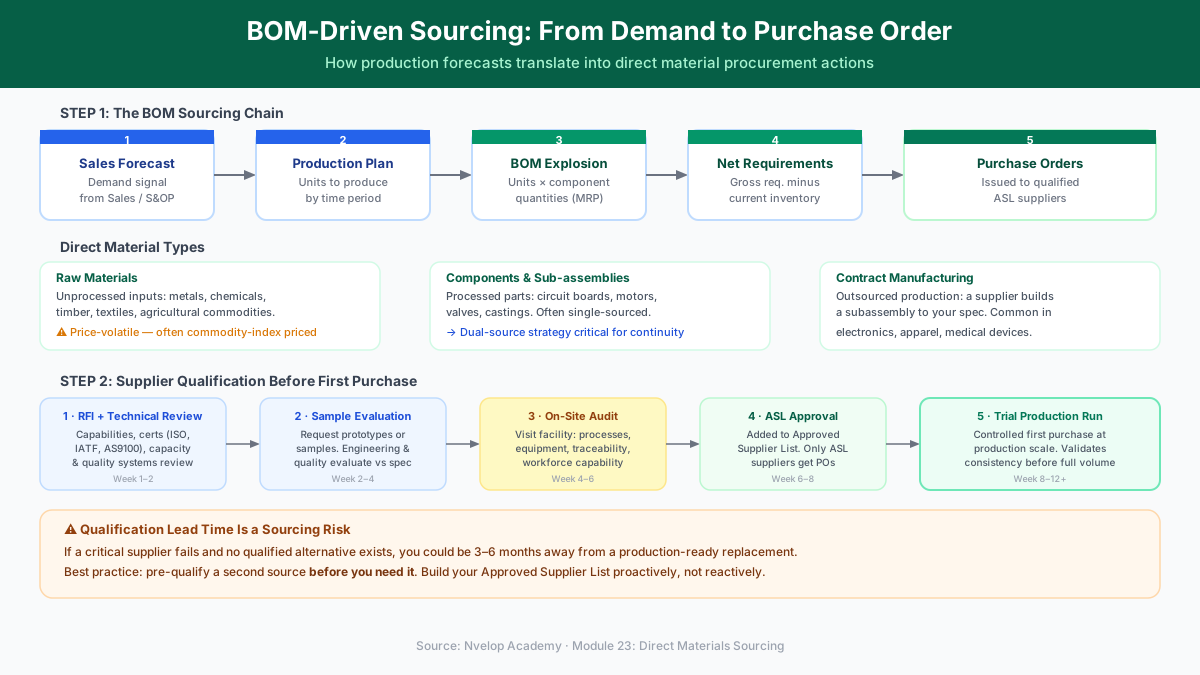
Types of Direct Material Spend
Raw Materials
Unprocessed inputs: metals, chemicals, timber, textiles, agricultural commodities. Price-volatile; often traded on commodity exchanges.
Components & Sub-assemblies
Processed parts that go into a finished product: circuit boards, motors, valves. Often single-sourced from specialist suppliers.
Contract Manufacturing
Outsourced production: a supplier builds an entire subassembly or finished product to your spec. Common in electronics and apparel.
Supplier Qualification and Approval
You can't source from a direct materials supplier who hasn't been qualified. Unlike indirect procurement, where you can often onboard a new vendor in days, direct material suppliers go through a formal qualification process that can take weeks or months.
The Qualification Process
RFI / Technical Review
Send a detailed information request covering technical capabilities, certifications (ISO, IATF, AS9100), capacity, and quality systems.
Sample / Prototype Evaluation
Request product samples or prototypes. Engineering and quality teams evaluate against specifications.
On-site Audit
Visit the supplier's facility to assess processes, equipment, traceability systems, and workforce capability. May include a PPAP in automotive.
Approved Supplier List (ASL)
Once qualified, the supplier is added to the ASL. Only ASL suppliers can be used for production; this gate prevents unqualified materials from entering the supply chain.
Trial Production Run
A controlled first purchase at production scale to validate consistency before full volume.
Qualification lead time is a sourcing risk.
If a critical supplier fails and no qualified alternative exists, you could be 3-6 months away from a replacement, all while production is constrained. Building a pre-qualified backup supplier before you need one is a standard risk mitigation practice.
Make vs Buy: When to Source Externally
Before you source a direct material externally, the organization must decide: should we make this ourselves or buy it from a supplier? This is the make vs buy decision, and it sits at the intersection of procurement, operations, and corporate strategy.
- Core to competitive differentiation or IP
- Proprietary process that suppliers can't replicate
- High volume where in-house cost < market price
- Quality or lead time requirements can't be met externally
- Supply security for critical components
- Suppliers have scale, expertise, or lower cost structure
- Capital investment to make in-house isn't justified
- Non-core activity that distracts from primary capability
- Faster to market by leveraging existing supplier capacity
- Risk transfer, quality and supply liability moves to supplier
Most organizations gradually shift more production toward “buy” as they scale, focusing internal resources on proprietary capabilities while outsourcing commoditized inputs. The risk is over-reliance on contract manufacturers for components that turn out to be strategically important.
Plan sourcing events and track supplier qualification status directly in Nvelop.
See Category PlanningSupply Continuity: Dual Sourcing and Risk Management
Direct material supply disruptions are costly. A single-source component shortage can shut down an assembly line that costs thousands of dollars per hour of downtime. Supply continuity planning is the practice of ensuring that critical materials are available even when things go wrong.
Dual Sourcing
Dual sourcing means qualifying and actively using two suppliers for the same material. The primary supplier gets the majority of volume (70-80%); the secondary supplier gets a meaningful share to keep them engaged and production-ready.
The cost vs. resilience tradeoff
Dual sourcing typically costs more: you sacrifice volume discounts by splitting the business, and you incur qualification costs for a second supplier. The question is whether that premium is justified by the continuity risk. For most strategic or bottleneck components, the answer is yes.
Other Continuity Levers
Safety stock
Hold buffer inventory above cycle stock to absorb supply delays. Sized based on demand variability and supplier lead time variance.
Long-term supply agreements
Multi-year contracts with capacity reservation clauses guarantee allocation during shortages (e.g., semiconductor supply agreements).
Supplier financial monitoring
Track supplier financial health to identify bankruptcy or distress signals before they cause a disruption.
Geographic diversification
Avoid concentrating supply in a single region vulnerable to geo-political risk, tariffs, or natural disasters.
Pricing Models for Direct Materials
Pricing decisions on direct materials flow straight to margin. Unlike indirect categories where you simply negotiate a rate, direct material pricing often involves formulas tied to costs or commodity indices.
When to use
Cost structure is stable and volume is predictable.
Pros
Budget certainty, simple to administer.
Cons
Supplier bears commodity risk; they may demand higher baseline prices to hedge.
When to use
Complex components where material + labor + overhead are visible.
Pros
Transparency into supplier economics; you share efficiency gains.
Cons
Requires open-book accounting; supplier has less incentive to reduce cost.
When to use
Commodity inputs (metals, resins, agricultural products) with public benchmarks.
Pros
Prices move with the market; neither party is locked into a losing position.
Cons
Budget volatility; requires hedging strategy to manage exposure.
When to use
Strategic partnerships with high-volume, high-spend suppliers.
Pros
Supply security + committed year-over-year cost reduction targets.
Cons
Requires forecasting accuracy; penalties if volumes miss committed levels.
Run Direct Material RFQs Faster
Send structured RFQs to multiple suppliers, compare responses side by side, and track awards in one place.