

Reactive purchasing is not a strategy.Five lessons to build a proactive program.
How to move beyond reactive purchasing: segmenting spend, bypassing distributors, developing suppliers, and optimizing total cost of ownership.
Lesson 01
Segmenting Direct Spend: Where to Focus Strategically
Not all direct spend deserves the same strategic attention. The first step is segmenting spend by value and risk, then applying the right sourcing approach to each segment.
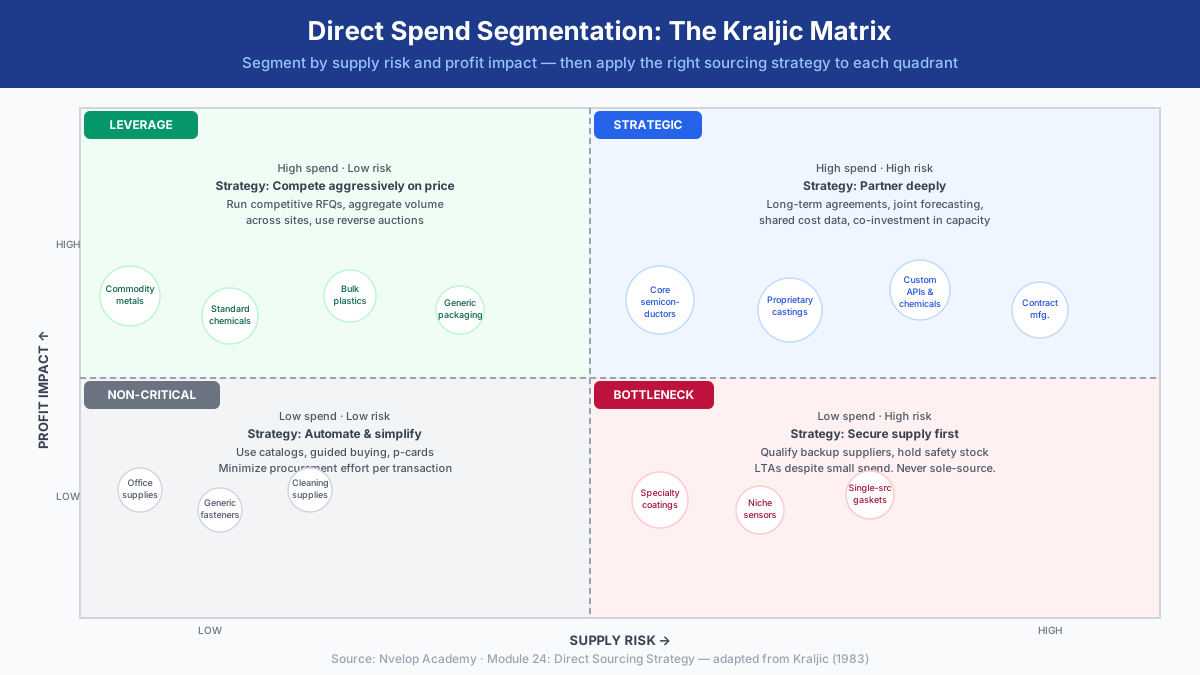
Figure 1: Kraljic spend segmentation matrix. Each quadrant requires a different sourcing strategy.
High spend, high supply risk. Core semiconductors, proprietary chemicals, single-source castings. These need long-term partnerships, co-development agreements, and executive-level supplier relationships.
High spend, low supply risk. Standard fasteners, commodity metals, generic chemicals. Multiple qualified suppliers exist; the strategy is competitive sourcing to drive down price.
Low spend, high supply risk. Small-value items where supply disruption halts production: specialty coatings, niche sensors. Disruption cost far exceeds purchase value.
See how Nvelop segments spend and routes each category to the right sourcing strategy.
Book a DemoLesson 02
Bypassing Distributors: Direct-from-Manufacturer Sourcing
A key strategic move in direct sourcing is identifying where you have sufficient volume to go direct to the manufacturer, cutting out distributor margin entirely.
Volume threshold reached
Once annual spend exceeds the manufacturer's minimum direct account threshold (often $250K to $500K), going direct is typically cost-justified.
Custom specifications required
If you need product modifications or custom part numbers, you must work directly with the manufacturer. A distributor cannot help.
Lead time is critical
Manufacturers can offer consignment stock, vendor-managed inventory (VMI), or priority allocation that distributors cannot guarantee.
Technical collaboration needed
New product introduction (NPI) or design-for-manufacturability (DFM) work requires direct engineering access, not possible through a distributor.
Don't abandon distributors entirely
Distributors still serve a purpose for low-volume, high-variety procurement: the tail of your BOM where ordering direct from 50 different manufacturers is not practical. A hybrid model (direct for strategic materials, distributor for tail components) is usually optimal.
Lesson 03
Supplier Development: Building Capability in Your Supply Base
When an important supplier cannot meet your requirements but switching is not practical, the answer is actively investing in improving that supplier's capabilities.
On-site process improvement
Deploy lean or quality engineers to the supplier site to identify and fix production inefficiencies. Common in automotive OEM relationships.
Training and knowledge transfer
Provide technical training on your specifications, quality standards, or testing methods. Reduces defect rates and rework costs.
Tooling investment
Invest in specialized tooling located at the supplier's site. Reduces their capital barrier to meeting your specs and ties them closer to your business.
Advance payments and financing
For financially stressed but capable suppliers, structured advance payments or supply chain financing can prevent failures before they happen.
Joint design and NPI collaboration
Involve key suppliers early in product design. They contribute design-for-manufacturability insights; you reduce late-stage specification changes.
Nvelop tracks supplier development investments and scorecards in one place.
See Vendor EvaluationLesson 04
Total Cost of Ownership for Direct Materials
In direct sourcing, the quoted purchase price is rarely the whole story. TCO analysis captures all costs from procurement through use, and often reveals the lowest-price supplier is not the lowest-cost option.
TCO components for direct materials:
Acquisition
Unit price, freight, duties, customs brokerage, currency exchange
Quality
Incoming inspection cost, defect rate, scrap/rework cost, warranty claims
Inventory
Safety stock carrying cost, obsolescence risk, warehouse space
Supply risk
Cost of expediting, premium freight for shortages, line downtime cost
Supplier management
Audit costs, qualification investment, relationship management time
Transition
Qualification cost if switching, tooling write-offs, revalidation testing
Price is not the same as cost
A supplier offering 10% lower unit price but shipping from a distant location with high defect rates and unreliable lead times may have a TCO that is 20% higher than the local, quality-stable alternative. TCO analysis should be part of every strategic sourcing decision for direct materials.
Lesson 05
Measuring Direct Sourcing Program Performance
A direct sourcing strategy without measurement is just intent. Mature programs track KPIs that span cost, quality, supply, and supplier development.
| KPI | What It Measures | Target |
|---|---|---|
Cost savings vs. target | Actual purchased price vs. should-cost or last year's price | Year-on-year reduction |
On-time delivery (OTD) | % of PO line items delivered on the requested date | >95% |
Incoming quality rate | % of receipts passing incoming inspection without rejection | >99% |
Supplier lead time | Avg. days from PO to delivery for each supplier and material | Reduce variability |
Dual source coverage | % of strategic/bottleneck materials with a qualified second source | 100% |
Spend under LTA | % of direct spend covered by long-term agreements | >70% |
Supplier development ROI | Cost savings or quality improvement from supplier development investments | Track per program |
Sourcing platforms add measurability
When all direct sourcing events run through a centralized platform, you get a clean audit trail and the data needed to calculate savings, track supplier performance, and report program results to leadership.
Build a Smarter Direct Sourcing Program
Nvelop gives your direct sourcing team structured RFQ workflows, supplier scorecards, and full decision auditability in one platform.
Keep learning
Related Courses
Category Management
Strategic procurement by category: Kraljic Matrix, spend analysis, and market strategy.
Supplier Management
Segmentation, performance tracking, risk assessment, and supplier development.
Direct vs Indirect Procurement
How spend is categorized and why the distinction drives your sourcing strategy.