

Every purchase is either direct or indirect.The distinction drives your entire strategy.
How spend is categorized, what separates direct from indirect purchasing, and why it shapes sourcing strategy, supplier relationships, and risk.
Direct procurement covers goods and services incorporated into the final product: raw materials, components, and contract manufacturing. Indirect procurement covers everything else: IT, facilities, professional services, and office supplies. The distinction matters because direct spend drives cost of goods sold and requires tight supplier relationships, while indirect spend is managed for efficiency, compliance, and cost control.
Go deeper
Ready to see how direct spend is sourced in practice? Explore direct materials sourcing next.
Lesson 01
What Is Direct Procurement?
Direct procurement covers goods and services directly incorporated into a company's products: the inputs your customers ultimately pay for.
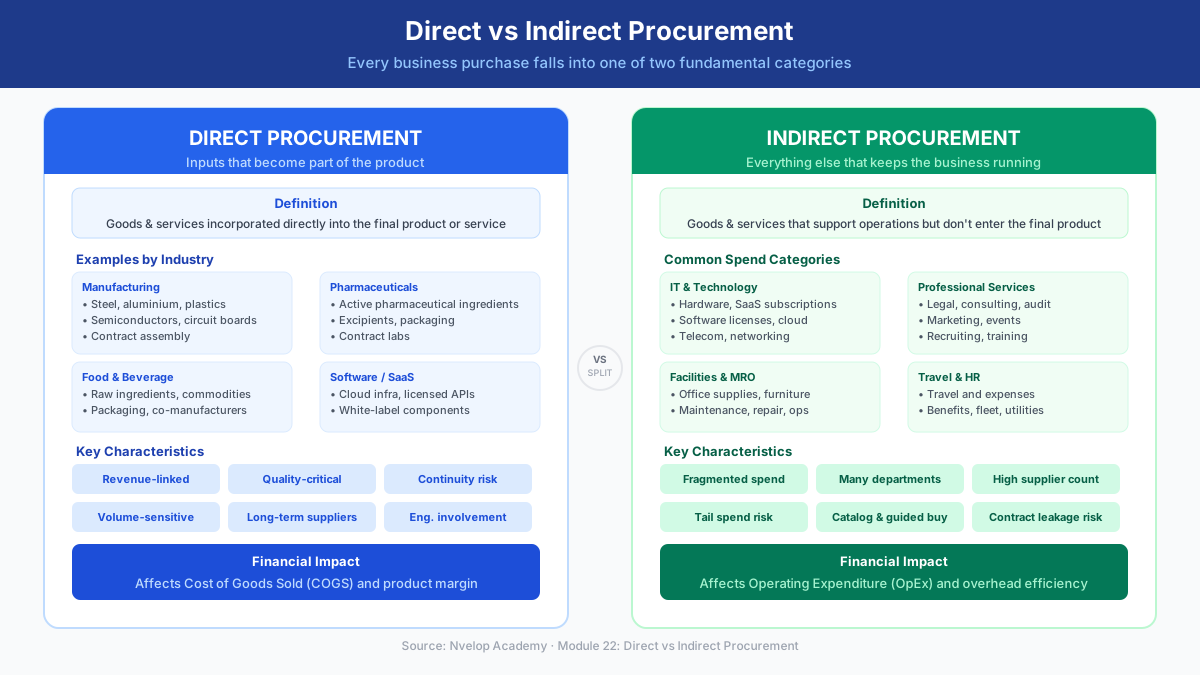
Figure 1: How every business purchase falls into one of two fundamental categories
Direct procurement examples by industry:
Manufacturing
Steel, semiconductors, plastic pellets, contract assembly
Food & Beverage
Raw ingredients, packaging materials, co-manufacturers
Pharmaceuticals
Active pharmaceutical ingredients (APIs), excipients, contract labs
Software / SaaS
Cloud infrastructure, licensed APIs, white-label components
Retail
Finished goods for resale, private-label merchandise
Characteristics of Direct Spend
Revenue-linked
Directly impacts cost of goods sold (COGS) and product margin.
Volume-sensitive
Purchased quantities driven by production forecasts and demand planning.
Quality-critical
Specifications are precise; deviations affect end-product quality.
Supply continuity risk
Shortages or supplier failures can halt production lines.
Longer relationships
Strategic suppliers require deep integration: EDI, VMI, JIT.
Engineering involvement
Specifications often set by R&D or engineering, not just procurement.
See how Nvelop keeps direct and indirect sourcing events organized in one platform.
Book a DemoLesson 02
What Is Indirect Procurement?
Indirect procurement covers everything a business buys to keep operations running (MRO, G&A spend, overhead) that never becomes part of the product itself.
Common indirect spend categories:
IT & Software
Hardware, SaaS, and licensed APIs
Facilities
Office supplies and building management
Professional Services
Legal, consulting, and audit
Marketing
Advertising, events, and agencies
Travel & Expense
Flights, hotels, and per diems
HR Services
Recruiting, training, and benefits
Utilities & Fleet
Telecoms, energy, and vehicles
MRO
Maintenance, repair, and operations
The tail spend problem
In most organizations, 80% of suppliers account for only 20% of spend. This tail (hundreds of small, unmanaged suppliers) is almost entirely indirect. Rationalizing it through preferred suppliers and catalogs is one of the fastest ways to reduce procurement overhead.
Lesson 03
Key Differences: Strategy, Risk, and Governance
The direct/indirect divide is not just a labeling exercise. It shapes how procurement teams structure their work, supplier relationships, and governance.
| Dimension | Direct Procurement | Indirect Procurement |
|---|---|---|
Strategic priority | High: tied to COGS and product quality | Medium: tied to operating efficiency |
Sourcing frequency | Ongoing / continuous replenishment | Project-based or periodic refresh |
Supplier relationships | Deep, long-term strategic partnerships | Transactional to preferred vendor programs |
Risk profile | Supply continuity, quality, geo-political | Maverick spend, contract leakage, compliance |
Key metrics | Lead time, defect rate, on-time delivery, COGS | Spend under management, cost avoidance, compliance rate |
Buying channel | PO-based, EDI, consignment, VMI | Catalog, guided buying, spot buy, p-card |
Sourcing events | RFQ for price competition, long-term contracts | RFP for complex services, blanket POs |
Organizational Ownership
In large enterprises, direct and indirect procurement are often managed by separate teams with different reporting lines. Direct procurement may report into supply chain or operations. Indirect typically reports into finance or a shared services center. In mid-market companies, a single team handles both, and the tension between the two is a constant prioritization challenge.
Lesson 04
Applying Sourcing Strategy by Category
The Kraljic Matrix segments spend by supply risk and profit impact. Direct materials almost always fall in Strategic or Bottleneck quadrants. Indirect spend is more commonly Leverage or Non-critical.
Niche or sole-source materials where disruption halts production despite small spend.
Core direct materials tied to COGS and product quality. Highest executive attention.
Tail indirect spend: office supplies, low-value services. Not worth heavy management.
Commodity or multi-source materials and high-volume indirect. Multiple qualified suppliers.
Practical Sourcing Decisions
High-spend direct material from a sole-source supplier
Develop a second source, negotiate long-term supply agreements, build inventory buffers.
Commodity direct material (e.g., bulk steel, standard fasteners)
Run competitive RFQs, use reverse auctions, aggregate volume across sites.
Fragmented indirect spend (e.g., SaaS tools bought by each team)
Rationalize to preferred vendors, implement a catalog, enforce PO policy.
High-value indirect service (e.g., enterprise software contract renewal)
Run a full RFP, benchmark against market, negotiate on multi-year terms.
FAQ
Frequently Asked Questions
Common questions about direct vs indirect procurement and spend categorization.
See Direct and Indirect Sourcing in Action
Nvelop handles both direct and indirect sourcing events in a single platform: RFQs, RFPs, supplier scorecards, and contracts.
Keep learning
Related Courses
Direct Materials Sourcing
How direct materials are sourced in practice: specifications, supplier selection, and supply continuity.
Category Management
Strategic procurement by category: Kraljic Matrix, spend analysis, and market strategy.
Sourcing Fundamentals
The complete step-by-step sourcing process from intake through award decisions and negotiation.