
Standardize parts across every unit.Unlock volume discounts.
How to consolidate specifications, aggregate demand, and negotiate volume discounts across your organization.
Course Overview
What you will learn.
Parts standardization is the practice of consolidating and unifying the specifications, components, and materials used across different business units so that an organization can aggregate demand, negotiate volume discounts, and reduce supply chain complexity. The best platforms for standardizing parts across business units provide centralized catalogs, cross-unit visibility, and demand aggregation tools that turn fragmented purchasing into coordinated, enterprise-wide sourcing.
Why Parts Standardization Matters
When business units independently specify and purchase similar components, the organization loses volume leverage, multiplies supplier relationships, and increases inventory complexity. Parts standardization consolidates this fragmented approach into coordinated purchasing that drives real cost savings.
10-25%
Cost Reduction
On standardized categories
30-50%
Fewer SKUs
Reduced catalog complexity
20-40%
Fewer Suppliers
Consolidated vendor base
15-30%
TCO Reduction
Total cost of ownership
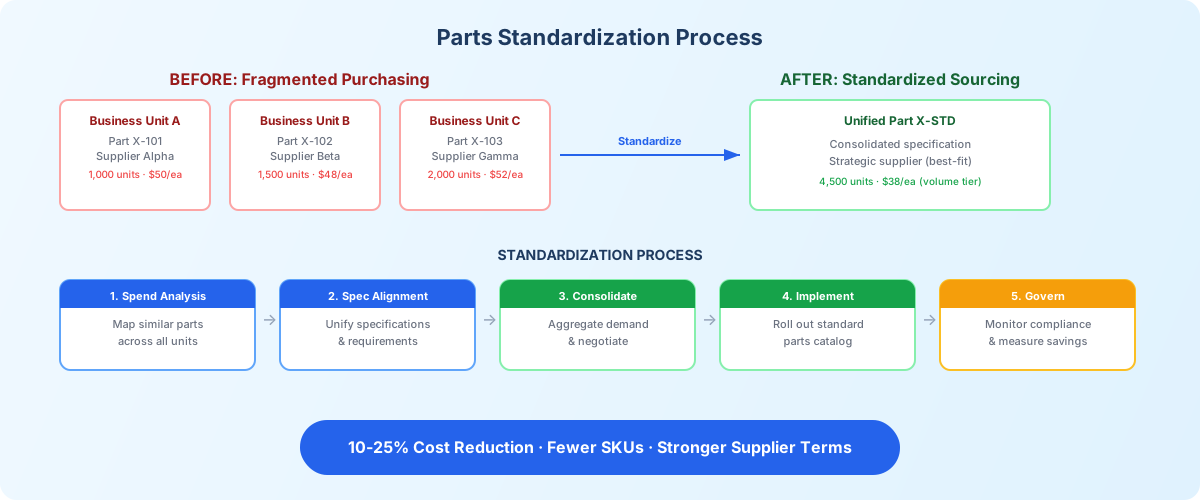
Figure 1: How parts standardization transforms fragmented purchasing into consolidated, volume-based sourcing.
Identifying Standardization Opportunities
The first step is finding where multiple business units are buying similar items from different suppliers at different prices. Here's a systematic approach to identifying the biggest standardization opportunities.
Cross-unit spend analysis
Aggregate spend data across all business units. Identify categories where multiple units buy similar items - IT hardware, office supplies, raw materials, MRO components, professional services.
Specification comparison
Compare specifications across business units for functionally equivalent parts. Often, units buy different brands or specs for the same function - laptop models, fastener grades, cleaning chemicals.
Pareto prioritization
Focus on the 20% of items that represent 80% of spend. High-spend, high-volume categories offer the biggest volume discount opportunities.
Supplier overlap mapping
Identify where different units use different suppliers for the same category. Consolidating to fewer suppliers for standardized parts creates the volume needed for better pricing.
Platforms and Tools for Parts Standardization
The best platforms for standardizing parts across business units provide the visibility, analytics, and workflow tools needed to identify opportunities, agree on standards, and enforce compliance across the organization.
Centralized Catalogs
A single source of truth for approved parts and specifications. Business units browse and select from standardized items rather than specifying independently.
Impact: Eliminates rogue buying from unapproved specs
Demand Aggregation
Tools that aggregate demand across business units automatically, showing total volume by standard part and enabling consolidated sourcing events.
Impact: Unlocks higher volume pricing tiers with suppliers
Specification Management
Version-controlled specification databases where engineering and procurement teams can define, approve, and publish standard specifications across the organization.
Impact: Single version of spec truth - no conflicting variants
Compliance Monitoring
Track adherence to standardized parts. Flag non-standard purchases for review. Measure compliance rates by business unit and category.
Impact: Prevents fragmentation from creeping back in
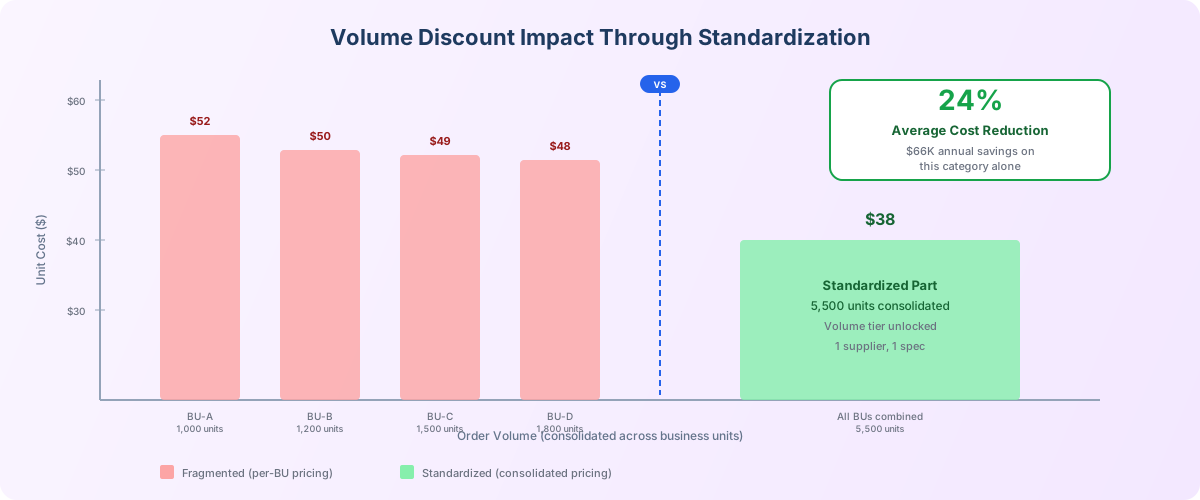
Figure 2: How consolidating demand across business units unlocks volume pricing tiers - 24% average cost reduction.
Building a Standardization Governance Framework
Standardization requires governance - clear ownership, decision processes, and rules for when exceptions are allowed. Without governance, business units will drift back to independent purchasing.
Cross-functional standards committee
Establish a committee with representatives from each business unit, engineering, procurement, and quality. They approve new standards, review exception requests, and monitor compliance.
Standard specification process
Define how standards are proposed, evaluated, tested, and approved. Include technical validation, supplier qualification, and business unit sign-off before a part becomes the enterprise standard.
Exception management
Allow exceptions when business units have legitimate needs for non-standard parts, but require documented justification, cost comparison, and committee approval. Track exception rates by unit.
Regular review cadence
Review standards quarterly. New products emerge, requirements change, and better alternatives become available. Keep the standards catalog current and relevant.
Measuring Impact: Volume Discounts and TCO Reduction
Measure standardization impact across three dimensions: direct cost savings from volume discounts, indirect savings from reduced complexity, and total cost of ownership improvements.
Direct Savings
- Volume discount improvements per category
- Price reduction per unit (before vs. after)
- Annual savings from consolidated contracts
Indirect Savings
- Reduced inventory holding costs (fewer SKUs)
- Lower administrative costs (fewer POs, suppliers)
- Reduced quality issues from consistent specs
TCO Improvements
- Maintenance cost reduction (standard parts)
- Training simplification (fewer variations)
- Supply chain risk reduction (fewer dependencies)
Start measuring before standardizing
Establish baseline metrics (current prices, number of SKUs, number of suppliers per category) before implementing standardization. You can't demonstrate ROI without a clear "before" snapshot.
Implementation: Getting Started with Standardization
Pick one high-spend category to pilot
Choose a category with high spend, multiple business units buying similar items, and willing stakeholders. IT hardware and office supplies are common starting points.
Map current specifications across units
Document what each business unit buys, from which suppliers, at what prices. Identify functionally equivalent items that differ only in brand or minor specifications.
Agree on enterprise standards with stakeholders
Work with business unit representatives to agree on standard specifications. Address concerns about quality, availability, and transition timelines.
Run a consolidated sourcing event
Use the aggregated volume to negotiate with suppliers. Run a competitive RFP with the consolidated demand to demonstrate the volume discount potential.
Measure results and expand
Document the savings achieved. Share results with leadership and other business units. Use the pilot success to build momentum for expanding to additional categories.
Common Standardization Mistakes
- • Imposing standards without involving business unit stakeholders
- • Standardizing too aggressively - some variations exist for valid technical reasons
- • Creating single-supplier dependencies through over-consolidation
- • Not maintaining an approved alternatives list for supply chain resilience
Frequently Asked Questions About Parts Standardization
Consolidate Your Sourcing for Better Pricing
Turn fragmented purchasing into volume-driven savings with Nvelop.