
How to Write an RFP That Gets
Useful Vendor Responses
The complete 8-step guide to writing and running an RFP - from defining requirements to awarding the contract - with templates, evaluation criteria, and the mistakes that sink most processes.
Course Overview
What you will learn.
An RFP (Request for Proposal) is a formal procurement document that a buying organisation issues to shortlisted suppliers. It asks them to propose a solution to a defined business problem, along with their approach, pricing, and terms. Used for complex or high-value purchases where price is one factor among several - not the only one.
What is an RFP?
An RFP is a formal procurement document that a buying organisation issues to a shortlist of suppliers, asking them to propose a solution to a defined business problem. Suppliers respond with their approach, proposed team, pricing, and terms. The buyer then evaluates responses against pre-defined criteria and awards the contract to the highest-scoring proposal.
Unlike a purchase order (where you already know what you want and the price is set) or an RFQ (where the specification is fixed and you primarily need competitive pricing), an RFP is used when the requirement is complex, the specification is not fully defined, or the buying organisation wants vendors to propose different solutions to the same problem.
Pro tip: An RFP is a legal document once issued
It creates an implied obligation to run a fair process and award on the stated criteria. If you issue an RFP and then award to a vendor that did not score highest without a documented reason, you are exposed to a formal challenge. Treat it accordingly from the moment it goes out.
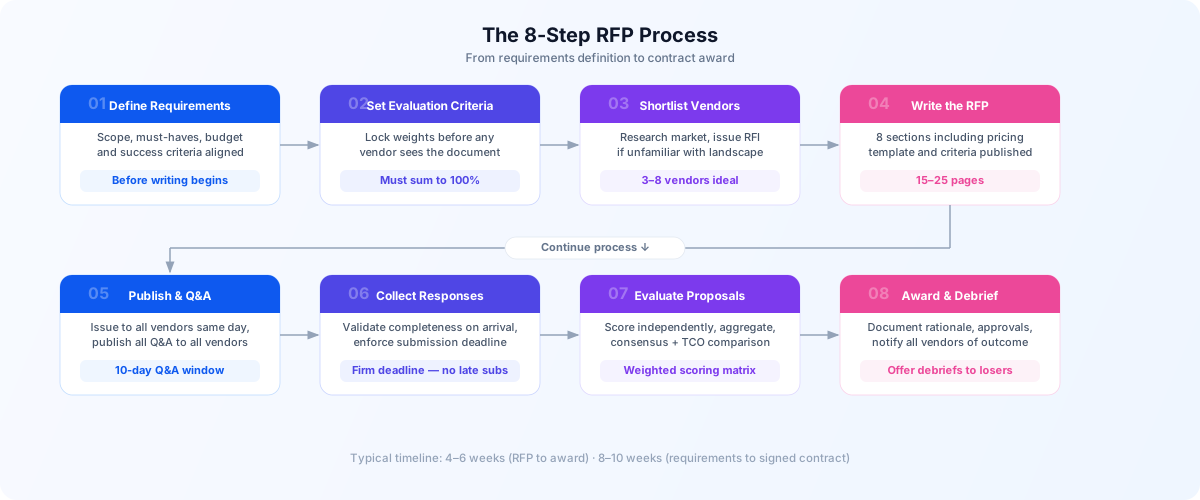
Figure 1: RFP process overview - from requirements definition to contract award
RFP vs RFQ vs RFI: Which Do You Need?
| Document | Use when | Evaluation basis | Commitment level |
|---|---|---|---|
| RFI | Market research; unfamiliar vendor landscape | None - information only | None |
| RFP | Complex purchase; vendor must propose solution | Solution quality + price + approach | Implied - intend to award |
| RFQ | Defined specification; need competitive pricing | Price and delivery terms | High |
The most common mistake is running an RFP when an RFQ would do, or running an RFQ when the specification is not actually fixed. If three vendors interpret your requirements differently and price accordingly, you do not have comparable quotes - you have three different proposals with no way to evaluate them fairly.
For a full decision framework, see RFP vs RFQ vs RFI: Full Guide.
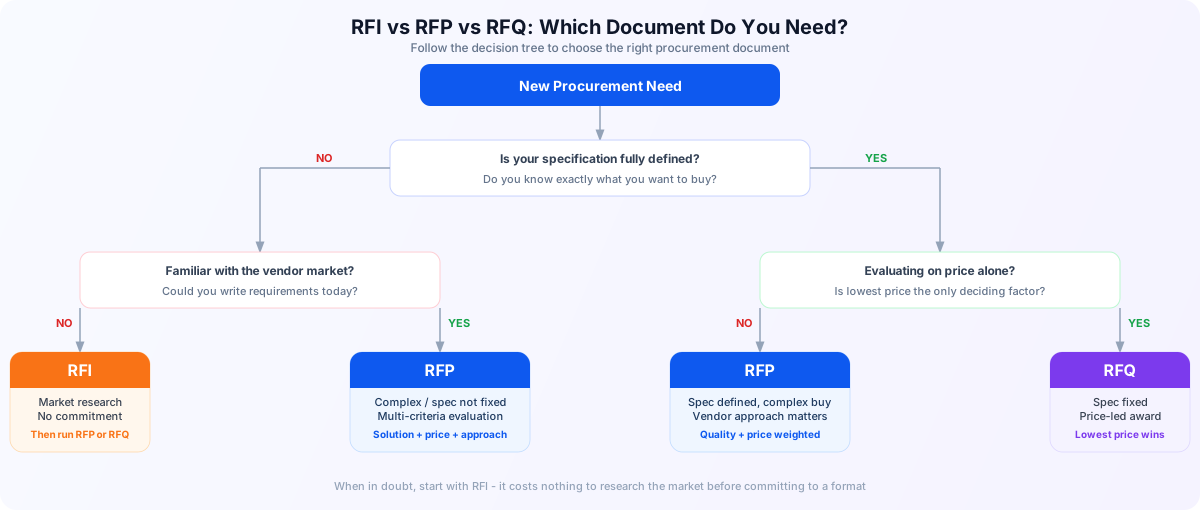
Figure 2: Decision tree - when to use RFI, RFP, or RFQ
The 8-Step RFP Process
A well-run RFP process is a sequence, not a sprint. Each step depends on the previous one being done properly.
Define requirements
Before writing a single word of the RFP, get internal alignment on what you actually need. What problem is being solved? What does success look like in 12 months? What are the must-haves vs. nice-to-haves? What is the indicative budget? Requirements defined during the writing process - rather than before it - produce vague RFPs that attract vague proposals.
Write requirements as outcomes, not specifications. "The system must process 10,000 invoices per month" is a requirement. "We need a good invoicing system" is not.
Define evaluation criteria
Set and lock your evaluation categories and weights before any vendor sees the RFP. Typical categories: technical capability, price/TCO, implementation approach, compliance and security, risk and financial stability. Weights must sum to 100%. These must be approved before the RFP is issued and must not change after proposals arrive.
Publish the evaluation criteria and weights inside the RFP document itself. Vendors who know how they will be scored write more targeted, useful proposals.
Research and shortlist vendors
If you are unfamiliar with the vendor market, issue a brief RFI first. Otherwise, identify three to eight qualified vendors through market research, referrals, or your existing supplier database. More than eight vendors creates disproportionate admin burden in Q&A and evaluation with diminishing returns on outcome quality.
Three to five vendors is the right number for most RFPs. Fewer gives you no competitive tension; more creates admin overhead without improving the award decision.
Write the RFP document
Structure the document: executive summary, scope of work, requirements, evaluation criteria, pricing template, timeline, terms and conditions, submission instructions. The pricing template is not optional - if vendors respond in different formats, you cannot compare them fairly. Keep the document concise; 15 to 25 pages covers most complex purchases.
AI procurement tools can generate a structured first draft in under 30 minutes from a requirements brief. A human review pass then takes one to two hours - compared to two to five days from scratch.
Publish and manage Q&A
Issue the RFP to all vendors simultaneously on the same day. Open a Q&A window - typically 10 days - for clarification questions. Publish all questions and answers to all vendors at the same time. A vendor that receives an answer another vendor did not see has an unfair advantage and you are exposed to a fairness challenge.
Never answer RFP questions by email to individual vendors. Use a portal or publish a shared Q&A log that every participating vendor can access.
Collect and validate responses
Set a firm submission deadline and enforce it. As proposals arrive, validate completeness: has every section been answered, has the pricing template been used, are all mandatory attachments included? Flag incomplete submissions before evaluation begins - not during.
A response checklist distributed with the RFP helps vendors self-validate before submitting, reducing incomplete responses and evaluation rework.
Evaluate proposals
Each evaluator scores proposals independently against the pre-defined criteria. Aggregate scores, identify scoring divergences, and hold a consensus session to agree a final ranking. Run a normalised price comparison using the standardised pricing templates. The highest weighted score plus total cost of ownership analysis informs the award recommendation.
Use a shared evaluation platform rather than individual spreadsheets. Version conflicts and unapproved score changes create audit risk.
Award and debrief
Document the award rationale before notifying anyone: scores by criterion, evaluator notes, price comparison, risk assessment. Obtain required approvals. Notify all vendors of the outcome. Offer unsuccessful vendors a brief, factual debrief - it reduces the likelihood of a formal challenge and improves future response quality.
The award memo is your protection if a losing vendor challenges the decision. Draft it before you notify anyone of the outcome.
What to Include in an RFP
Every section below serves a purpose. The two most commonly omitted - the pricing template and the published evaluation criteria - are also the two that do the most damage when missing.
3-8
Optimal vendors to invite
Fewer = no competition; more = admin overload
5-10%
Average cost reduction
From increased competitive tension
40%
Cycle time reduction
With AI-assisted RFP tools
80%
RFP failures
Caused by unclear requirements upfront
Executive summary
01Who you are, the business context, and the problem you are solving. 1-2 pages. Helps vendors assess genuine fit before investing in a full response.
Scope of work
02A precise description of what the vendor must deliver: outputs, deliverables, geographic scope, and what is explicitly excluded.
Requirements
03Functional, technical, and compliance requirements. Categorised as mandatory (must have) and desirable (nice to have). Numbered so vendors can respond to each one specifically.
Evaluation criteria and weights
04The categories and percentage weights you will use to score proposals. Published upfront so vendors know how they will be judged.
Pricing template
05A standardised format all vendors must complete. Defines line items, units, assumptions, contract length, and currency. Without this, proposals are not comparable.
Timeline and milestones
06Issue date, Q&A window close, submission deadline, evaluation period, expected award date, go-live target.
Terms and conditions
07Mandatory contractual, legal, and regulatory requirements vendors must accept. Surfacing deal-breakers early saves time for both parties.
Submission instructions
08File format, page limits, font requirements, submission email or portal, and deadline. Inconsistent formats create unnecessary evaluation work.
Download ready-to-use templates: requirements readiness checklist, RFP checklist, evaluation scorecard, pricing template, supplier Q&A log, and award memo.
How to Write RFP Evaluation Criteria
Evaluation criteria are the most important part of an RFP. They determine who wins, how the decision is documented, and whether the process can be defended if challenged.
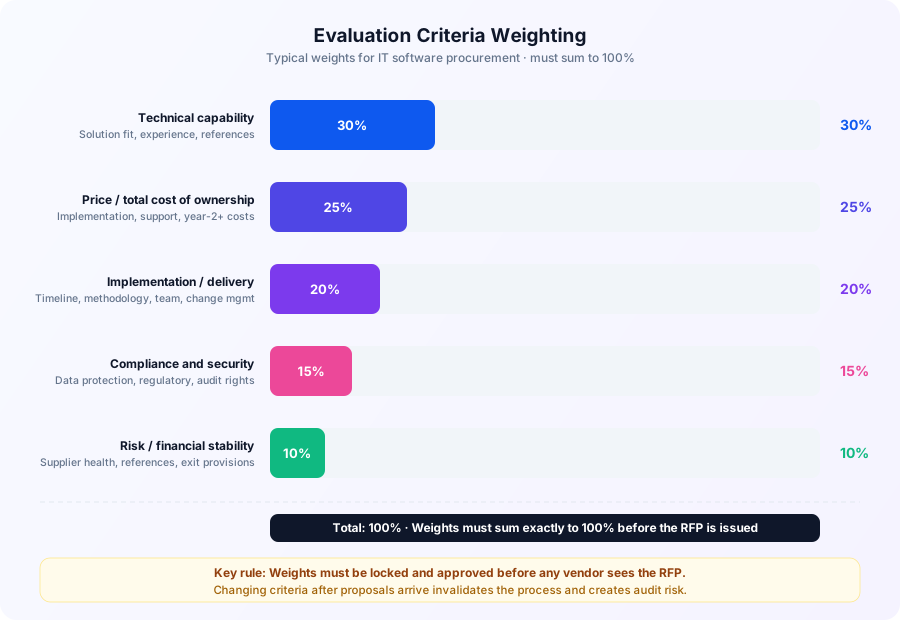
Figure 3: Typical evaluation criteria weighting for IT software procurement
Scoring definitions (5-point scale)
| Score | Label | Definition |
|---|---|---|
| 5 | Excellent | Fully meets the requirement; response is specific, evidenced, and compelling |
| 4 | Good | Substantially meets the requirement with minor gaps |
| 3 | Adequate | Meets minimum requirements; some aspects undeveloped |
| 2 | Weak | Partially meets requirements; significant gaps or unclear response |
| 1 | Inadequate | Does not meet the requirement; generic or no response provided |
Typical evaluation weightings by project type
| Category | IT Software | IT Services | Prof. Services | Facilities | Construction |
|---|---|---|---|---|---|
| Technical capability | 30% | 30% | 35% | 25% | 30% |
| Price / TCO | 25% | 25% | 25% | 35% | 40% |
| Implementation / delivery | 20% | 25% | 20% | 20% | 15% |
| Compliance and security | 15% | 10% | 10% | 10% | 10% |
| Risk / financial stability | 10% | 10% | 10% | 10% | 5% |
| Total | 100% | 100% | 100% | 100% | 100% |
Common mistake: using a 10-point scale with no definitions
Evaluators diverge widely ("I gave it a 7" vs "I gave it a 4") because they are applying different internal benchmarks. Define what each score means - in writing - before evaluation starts. Without definitions, your scores reflect individual interpretation, not a consistent standard.
Download the free evaluation scorecard template with pre-built weighted criteria for IT, services, and facilities RFPs.
RFP Timeline: How Long Does an RFP Take?
A typical RFP runs four to six weeks from publication to award decision. The total sourcing cycle - from requirements definition to signed contract - is usually eight to twelve weeks depending on complexity and the number of internal approvers.
RFP timeline by project type
| Project type | Preparation | Live (Q&A + responses) | Evaluation | Total |
|---|---|---|---|---|
| Simple services RFP | 1 week | 2 weeks | 1 week | 4 weeks |
| IT software RFP | 1-2 weeks | 3 weeks | 2 weeks | 6-7 weeks |
| Complex IT / systems | 2-3 weeks | 4 weeks | 3 weeks | 9-10 weeks |
| Major infrastructure | 4-6 weeks | 6-8 weeks | 4-6 weeks | 14-20 weeks |
Pro tip: Add one week buffer to every timeline you publish
Vendor questions always surface issues that require internal clarification. Internal approvers always take longer than expected. A timeline that assumes everything goes right is a timeline that will slip - and a slipped deadline signals to vendors that your process is poorly managed.
7 Common RFP Mistakes
Most failed or challenged RFP processes trace back to one of seven root causes.
Writing the RFP before the requirements are agreed
The document reflects the first draft of internal thinking, not the signed-off requirement. Vendors sense the ambiguity and respond with hedging language that is difficult to evaluate fairly.
Copying last year's RFP without updating it
Scope changes, market conditions change, and lessons from the last evaluation are ignored. The result is an RFP that does not reflect current needs and attracts responses that miss the point.
Omitting the pricing template
Vendors respond in their preferred format: one quotes per seat, another quotes per transaction, another quotes a fixed fee. You cannot compare them. Price comparison becomes guesswork.
Undefined evaluation criteria
Vendors do not know how they will be scored so they cannot write targeted proposals. Evaluators are left to decide criteria after seeing the proposals - which is backwards and indefensible.
Asymmetric Q&A - answering individual vendor questions privately
One vendor learns something others do not. The process is compromised and you are exposed to a fairness challenge. All questions and answers must be published to all vendors simultaneously.
Too short a response window
Vendors submit template responses because there was not enough time for a considered proposal. A one-week window for a complex purchase signals that you are not a serious buyer.
No documented award rationale
You know who won and why, but it is not written down. A losing vendor asks for a debrief. You have no defensible record. The award memo must exist before you notify anyone of the outcome.
The hardest mistake to recover from
Treating the RFP as a formality when the decision is already made. Vendors eventually work this out - and stop investing in serious responses to your future sourcing events. A rigged process produces one bad outcome; a reputation for rigged processes produces a market that stops competing for your business.
Nvelop RFX Platform
Write your next RFP in 30 minutes, not three days.
AI generates a fully structured RFP draft from your requirements brief. Manage vendor Q&A, score proposals, and produce a defensible audit record - all from one platform.
RFP Written Manually vs Built with AI: What Changes
Side-by-side comparison across six dimensions of a typical enterprise RFP process.
| Dimension | Manual RFP | AI-assisted RFP (Nvelop) |
|---|---|---|
| Document creation | 2-5 days (Word, email, manual formatting) | Under 30 minutes (AI draft from requirements brief) |
| Requirements capture | Unstructured notes, inconsistent quality | Structured intake with completeness checks |
| Vendor Q&A management | Email threads; answers sent inconsistently | Centralised portal; all vendors receive all answers |
| Proposal evaluation | Individual spreadsheets; version conflicts | Shared platform; independent scoring with full audit trail |
| Pricing comparison | Manual normalisation; often not comparable | Standardised template; AI normalises and compares |
| Audit documentation | Assembled after the fact; often incomplete | Generated automatically throughout the process |
FAQ
Frequently asked questions about writing RFPs.
Common questions about the RFP process, evaluation criteria, vendor management, and running a fair process.
Keep learning
Related Courses
RFX Explained
When to use RFI, RFP, RFQ, and RFS - and how to run each type of sourcing event.
RFX Automation Guide
How AI automates RFP creation, vendor Q&A, proposal scoring, and compliance tracking.
Free Requirements Readiness Checklist
Confirm scope, deliverables, technical requirements, and evaluation criteria are complete before the RFP goes out.
Free Supplier Q&A Log Template
Track all vendor questions and official answers during the RFP process - anonymised, distributable, audit-ready.
Free Award Memo Template
Document your vendor selection decision and award rationale before notifying any vendor of the outcome.
Free Evaluation Scorecard Template
Ready-to-use vendor scoring template with weighted criteria for IT, services, and facilities RFPs.
Ready to run your next RFP?
Nvelop generates the document, manages vendor Q&A, scores proposals, and produces the audit record - all from one platform.