
Data Security
DSPT compliance and NHS data governance framework alignment for all data processing.

Financial services, healthcare, and defence teams face data residency, audit, and compliance requirements that most cloud-based tools were not designed to meet.
Context
Regulated industries face procurement compliance challenges that standard spend analytics tools were not designed to address. The combination of strict data handling rules, sector-specific audit requirements, and supplier sensitivity creates a set of constraints that most cloud-first vendors treat as edge cases.
Three factors separate regulated industries from general enterprise procurement. First, data sovereignty - where spend data can physically reside is constrained by regulation, not just preference. Second, audit depth - the level of detail required in an audit trail goes beyond standard activity logs. Third, supplier sensitivity - who your suppliers are, and how much you spend with them, can be commercially or operationally sensitive.
This guide addresses each sector in turn, covering the specific regulatory requirements procurement teams need to account for when selecting or evaluating a spend analytics platform.
Data Sovereignty
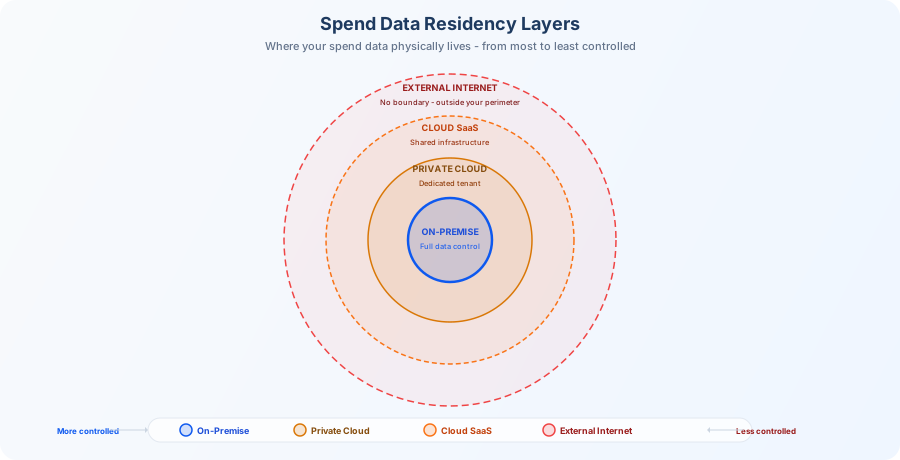
Where your spend data physically resides is determined by regulation, not vendor preference. Most SaaS platforms store data in shared infrastructure you do not control.
Audit Depth
Immutable, tamper-evident logs with user-level attribution - not just activity summaries. Regulators expect to see who accessed what, when, and why.
Supplier Sensitivity
Supplier identities and spend volumes can carry commercial and operational sensitivity that standard cloud tools were not designed to protect.
Core challenge
When procurement teams use a standard cloud-based spend analytics platform, their spend data typically flows through shared infrastructure hosted in the vendor's chosen region. For most organisations, this is acceptable. For regulated industries, it often is not.
GDPR, UK GDPR, and sector-specific frameworks may restrict where certain categories of operational data can reside. Multi-tenant SaaS platforms pool data across customers - and even with logical separation, this architecture creates a risk profile that many regulated organisations cannot accept.
NIS2 (effective October 2024) extends cybersecurity and supply chain security obligations to financial services, healthcare, and other critical sectors across the EU. It adds further scrutiny to the third-party platforms these organisations use, making the deployment model of a spend analytics platform a compliance question, not just a commercial one.
The practical implication is that procurement teams need to evaluate not just what a platform does, but where and how it handles data - before any contract is signed.
Regulatory restriction
GDPR, UK GDPR, and sector-specific data governance frameworks may prohibit sending procurement data to certain jurisdictions without an explicit legal basis for the transfer.
Multi-tenant commingling
Shared infrastructure pools data across customers. Even logically separated, this architecture introduces risk in heavily regulated environments.
Breach notification
A platform-level breach may prevent your organisation from meeting its own regulatory breach notification timelines if the vendor controls the incident response.
Audit trail ownership
In a cloud environment, the completeness and integrity of audit logs depends on vendor cooperation. On-premise deployment keeps that control in-house.
Sector: Financial services
Financial services procurement operates under some of the most demanding audit and data governance requirements of any sector. Firms regulated by the FCA, PRA, SEC, or equivalent bodies must maintain detailed records of procurement decisions, supplier due diligence, and third-party risk assessments.
DORA (the EU Digital Operational Resilience Act, effective January 2025) adds further requirements for financial services firms operating in the EU, mandating documentation of ICT third-party supplier relationships, concentration risk reporting, and exit strategy planning. Spend analytics data feeds directly into all three.
For financial services procurement teams, the right spend analytics platform must treat compliance as a first-class requirement, not a configuration option.
Key requirements
Immutable audit logs with user-level attribution and timestamps
DORA Article 28 alignment for ICT third-party risk documentation
Role-based access controls at field level, not just page level
ISO 27001 or SOC 2 Type II certified infrastructure (or equivalent)
Third-party risk metadata stored alongside spend data
Supplier data handled as potentially commercially sensitive
Export formats compatible with regulatory reporting frameworks
Contractual guarantees on data location and incident notification
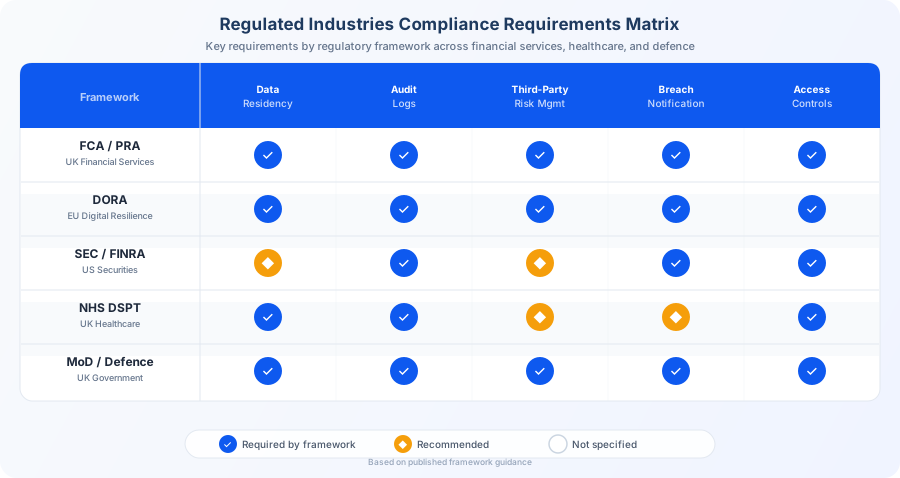
The matrix below covers requirements across all three regulated sectors covered in this guide - not financial services alone.
Sector: Healthcare
Healthcare procurement sits at the intersection of cost pressure and regulatory complexity. NHS trusts, private hospital groups, and pharmaceutical manufacturers must demonstrate value for money while maintaining complete traceability of medical device and pharmaceutical spend.
The Data Security and Protection Toolkit (DSPT) sets data governance expectations for NHS organisations. Beyond DSPT, the NHS eProcurement Strategy requires alignment with GS1 standards for product identification, and NHS eProcurement taxonomy for spend categorisation. A spend analytics platform that cannot ingest GS1-coded data will require manual data transformation before any analysis is possible.
For US healthcare organisations and those with US operations, HIPAA's administrative safeguard requirements - particularly around access controls, audit trails, and transmission security - apply to any platform that handles data linked to patient care activity. The HIPAA question is covered in detail in the FAQ below.
For healthcare procurement teams, supplier certification status and contract compliance tracking are as important as spend volume data.
DSPT compliance and NHS data governance framework alignment for all data processing.
Native ingestion of GS1-coded product data from NHS Supply Chain and direct supplier feeds.
Full procurement-to-payment traceability for medical device and pharmaceutical categories.
Supplier accreditation status surfaced alongside spend data, not in a separate system.
Sector: Defence and government
Defence and government procurement carries the most stringent data handling requirements of any sector. Spend data in this context can reveal operational priorities, supply chain structure, and strategic supplier relationships that are sensitive beyond the commercial.
For the UK Ministry of Defence and defence contractors, spend analytics platforms must typically support deployment at Official or Official-Sensitive classification levels under the Government Security Classifications Policy (formerly IL2/IL3), which effectively rules out standard multi-tenant SaaS. US defence contractors subject to ITAR restrictions face equivalent constraints on where procurement data relating to controlled items can flow.
Central government procurement teams in the UK operate within G-Cloud and Crown Commercial Service (CCS) frameworks, which set baseline expectations for security classification, data handling, and supplier assurance that must be reflected in any platform selection.
Deployment requirements
On-premise by default
Standard SaaS is rarely acceptable at Official-Sensitive classification and above. On-premise or private infrastructure is the baseline expectation.
ITAR, CMMC and CUI
US defence contractors must ensure procurement data relating to controlled items does not transit non-US infrastructure. CMMC requirements and Controlled Unclassified Information (CUI) handling protocols impose additional constraints on prime contractors and their supply chain.
Security vetting of platform staff
Platform vendors with access to defence spend data may require security clearance in some contexts.
G-Cloud alignment
UK central government procurement platforms should be listed on or compatible with the G-Cloud framework.
Offline capability
Some defence environments require analytics capability that functions without internet access.
Evaluation guide
The vendor conversation for regulated industries needs to cover territory that standard procurement software RFPs rarely reach. These questions separate platforms designed for regulated environments from those retrofitting compliance as an afterthought.
| Question | What a strong answer looks like | Priority |
|---|---|---|
| Where exactly is our spend data stored, processed, and backed up? | Specific data centre region(s), contractual guarantee that data does not leave stated geography without written consent. | Critical |
| Is our data physically or logically separated from other customers? | Physical separation (dedicated infrastructure) rather than logical isolation in a shared environment. | Critical |
| Can the platform be deployed on-premise on our own infrastructure? | Yes, with the same feature set as the cloud version - not a stripped-down variant. | Critical |
| What does your audit log cover and how long is it retained? | Every data access, export, and configuration change, with user-level attribution, retained for at least 7 years, immutable. | High |
| What is your SOC 2 Type II or ISO 27001 certification status and penetration test cadence? | Current SOC 2 Type II report or ISO 27001 certificate available on request, annual third-party penetration testing. | High |
| What is your incident response SLA and notification obligation to us? | 72-hour contractual notification obligation (matching GDPR), with defined escalation path. | High |
| Does the platform support SAML/OIDC integration with our identity provider? | Yes, with attribute-based access control (ABAC) at field level, not just role level. | Medium |
| Can we export a complete copy of our data in machine-readable format? | Self-service export in structured format (CSV, JSON) at any time, not only on contract termination. | Medium |
Deployment decision
For regulated industries, the choice between cloud and on-premise is primarily a regulatory question, not a technical one. This comparison covers the criteria that matter.
| Criteria | Cloud (SaaS) | Private cloud / Dedicated tenant | On-premise |
|---|---|---|---|
| Data residency control | Vendor-controlled | Negotiable | Full control |
| Deployment time | Days | Weeks | Weeks to months |
| Infrastructure cost | Included in licence | Higher licence cost | Separate infra cost |
| Audit log ownership | Vendor-managed infrastructure | Negotiable | Full ownership |
| Regulatory suitability | Commercial sectors | Financial services, Healthcare | Defence, Government, High-security Financial Services |
| Data commingling risk | Multi-tenant | Isolated | None |
| Update cadence | Automatic | Scheduled | Controlled by you |
Many vendors advertise on-premise capability but in practice offer only a "dedicated tenant" on their own infrastructure - which does not satisfy strict data sovereignty requirements. Ask specifically whether on-premise means software that runs on your hardware, managed entirely by you, with no data egress to vendor systems. Validate this in a proof of concept, not in a sales conversation.
Implementation
Regulated industry implementations have additional complexity that standard cloud deployments do not. Procurement teams should plan for longer data validation cycles, more stakeholders in the sign-off process, and tighter integration testing with existing ERP and compliance systems.
The most common implementation delay is not technical - it is data governance sign-off. IT security reviews, legal review of data processing agreements, and internal procurement of the platform itself can each add weeks to a timeline that the vendor's sales presentation did not account for. Plan for 3-6 months for financial services and healthcare; for defence and government, 6-12 months is more realistic - security accreditation and supply chain vetting of the vendor add time that has nothing to do with the platform itself.
See how Nvelop's spend analytics platform handles regulated industry deployments, including on-premise options and the documentation required to satisfy internal governance.
Data governance sign-off first
Secure internal approval for data handling arrangements before vendor selection. This prevents the most common delay - discovering a legal blocker after contract signature.
IT security review early
Include IT security in the vendor evaluation process, not after selection. Many regulated-industry security requirements eliminate vendors early in the process.
Plan for data validation time
Regulated industries typically have more complex spend data - multiple ERP systems, multi-entity structures, and historical data gaps. Allow additional time for cleansing and validation.
Define audit log requirements before configuration
Agree with compliance and legal what the audit log must capture, at what granularity, and for how long - before the platform is configured, not after.
Run a controlled pilot
Start with a single category or business unit. Validate the data quality, compliance posture, and user adoption in a controlled environment before full rollout.
FAQ
Common questions from procurement teams in regulated industries evaluating spend analytics platforms.
Next steps
Nvelop's spend analytics platform supports on-premise deployment, immutable audit logging, and the compliance documentation that regulated industry procurement teams require. No multi-tenant data commingling, no data egress to vendor systems.
For regulated industry procurement teams
See how Nvelop deploys in your environment - on-premise, private cloud, or dedicated tenant - with the audit trail and compliance documentation your governance team will require.
Book a DemoPlatform overview
Explore the full spend analytics feature set - from automated spend classification to supplier risk overlays and regulatory export formats.
See the Analytics PlatformKeep reading
A foundational guide to spend analytics - what it covers, how classification works, and what questions it can answer for your procurement team.
When a general-purpose BI platform is the right choice - and when a dedicated spend analytics tool is worth the investment. A practical comparison.
How Nvelop supports procurement audit readiness - from immutable activity logs to structured exports for regulatory reporting.